Historical Lineage.

Sticky Hands
Soke Warren
4/14/20253 min read
Sticky Hand Training: Learning to Block and Strike with Sensitivity
In martial arts, true skill is often revealed not at long distance, but within inches of an opponent. When distance closes, reaction time must become instinctive. One effective method used to develop this skill is sticky hands training, a sensitivity drill designed to teach practitioners how to block, redirect, and strike fluidly in close-range encounters.
Within the teachings of the Nisei Bujutsu, sticky hand training reinforces awareness, balance, and controlled power—principles emphasized by the founder, Soke Harris Warren, who continues to teach and demonstrate the importance of precision and discipline in martial arts training.
What Is Sticky Hands Training?
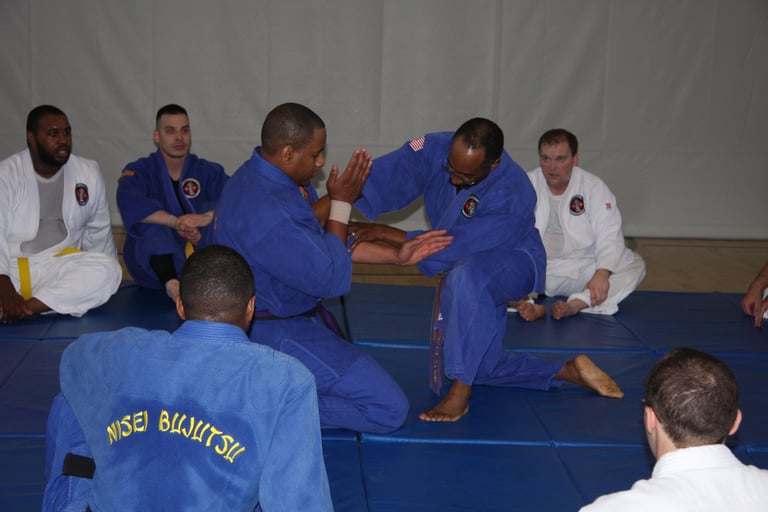
Sticky hands is a partner drill where two practitioners maintain light contact between their forearms or hands while moving continuously. Instead of separating after each motion, both partners remain connected, learning to feel pressure, direction, and openings in real time.
This constant contact trains the body to recognize subtle changes in movement. As a result, the practitioner can react almost instantly, without relying solely on sight.
Through regular practice, students develop:
Sensitivity to incoming attacks
Improved reflex timing
Efficient redirection of force
Smooth transition from defense to offense
These skills are essential for effective close-quarter defense, where traditional blocking methods may be too slow.
Learning to Block Through Sensitivity
Sticky hand training teaches that a block does not always require strength. Instead, students learn the principle of guiding an attack rather than stopping it directly.
For example, during the drill:
Two practitioners maintain light forearm contact.
One partner initiates a controlled forward strike or push.
The other partner senses the movement through touch.
The defender redirects the force slightly off its path.
Because the defender feels the attack early, the block becomes efficient and relaxed, conserving energy while maintaining control.
This approach aligns with the philosophy taught by Soke Harris Warren, who emphasizes that martial arts mastery involves timing and awareness rather than brute force.
From Block to Counterstrike
One of the greatest advantages of sticky hands practice is the ability to transition immediately from defense to offense.
Since both practitioners remain connected, the defender already knows where the opponent’s balance and openings are located. This allows for a quick and precise counterstrike.
A typical sequence may include:
Redirecting an incoming strike
Maintaining contact with the opponent’s arm
Delivering a controlled counterstrike to an open target
This seamless transition helps students understand an important martial arts principle:
Defense and offense should occur within the same motion.
Benefits for Martial Arts Students
Sticky hands drills offer several important training benefits for students practicing Nisei Bujutsu and other traditional martial arts disciplines.
Key benefits include:
Improved reflexes
Students learn to react instantly to physical cues.
Greater hand coordination
Continuous contact improves precision and control.
Enhanced situational awareness
Practitioners learn to sense movement even without direct visual focus.
Better close-range confidence
Students become comfortable managing attacks at very short distances.
These attributes contribute to more effective sparring, self-defense capability, and overall martial arts development.
Training Wisdom from Soke Harris Warren
According to Soke Harris Warren, martial arts training is not simply about memorizing techniques. True skill develops through consistent practice that builds awareness, discipline, and control.
Sticky hand drills embody this philosophy. They teach students to remain calm under pressure, feel the movement of an opponent, and respond with clarity rather than hesitation.
In this way, sticky hand training becomes more than a technique drill—it becomes a lesson in awareness, balance, and controlled response.
Final Thoughts
Sticky hand training offers a powerful method for developing blocking, redirection, and striking skills at close range. By maintaining contact and learning to feel movement, martial artists cultivate a deeper level of responsiveness and control.
For practitioners studying under the traditions of Nisei Bujutsu, these drills reinforce the timeless martial principle that true power lies in awareness, timing, and disciplined practice.